

How to Buy Market Research in the Age of AI: What Has Changed – and What Hasn’t

Sara Parikh, PhD
Owner and President, Willow Research LLC
I started my career in market research working for Leo J. Shapiro & Associates. The firm was well-established when I joined, and Leo was a pioneer in the industry. After completing his PhD in Sociology at the University of Chicago, Leo thought there might be commercial applications for the kinds of research tools that he learned about in his graduate studies. When he started the company in the 1950s, few client companies were using original research to understand their customers or markets.
Hoping to find some clients, Leo put together a presentation called “How to Buy Market Research” and put up flyers around downtown Chicago promoting his talk. An executive for Jewel Foods company attended the talk, beginning a decades-long relationship with Leo and our firm.
The work we did for Jewel Foods and other clients was grounded in social science research principles and methods. But the tools we use have evolved considerably over the years – from door-to-door and phone interviews, mall intercepts and in-person focus groups, to online surveys, virtual interviews, mobile ethnographies and more.
Artificial intelligence is the latest innovation in an ever evolving and highly adaptable industry. Indeed, major research and client organizations have already incorporated AI into various aspects of their research processes and platforms. These developments are real and, in some cases, quite significant.
At the same time, many of the questions organizations bring to research partners today are remarkably similar to the questions they have been asking for decades:
- What do our customers actually want?
- How and why are behaviors changing?
- Which opportunities deserve investment?
- What evidence can we trust?
While the tools are evolving, the underlying decisions are not.
What Has Changed and What Hasn’t
What Has Changed
For much of the history of market research, a major challenge for organizations was having access to original data from actual customers.
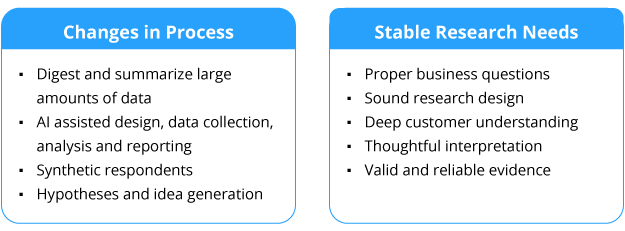
Today, organizations often have more information than they know what to do with. They have customer feedback platforms, customer reviews, customer support interactions, social listening data, transactional data, website analytics, and years of original research. On top of that, AI tools can now summarize information, identify themes, generate hypotheses, and surface patterns within seconds.
The challenge is no longer simply gathering information. It is determining what matters. Which findings are meaningful? Which patterns deserve attention? Which explanations are credible? Which insights should influence important business decisions? Those questions are not new. If anything, they become more important as information becomes easier to generate.
How AI Is Being Used Today
One area where AI has demonstrated clear value is qualitative analysis. Analyzing qualitative data has historically been one of the most laborious and time-consuming tasks for researchers. With the help of AI, we can now rapidly digest and review large volumes of open-ended verbatim responses and interview transcripts, helping us organize information and identify themes and patterns much more efficiently.
AI is also being used to identify patterns across large datasets in quantitative research. Established research organizations like Kantar and Nielsen have integrated AI into their platforms to uncover insights more efficiently from disparate data sources.
AI is also being used in qualitative interviewing, research design and idea generation. The AI-native startup, Conveo, for example, uses AI-moderated interviews to support large-scale qualitative research. Delve AI offers synthetic personas and digital twins that can be used to explore ideas and generate hypotheses.
No AI application has generated more discussion in the research industry than synthetic respondents. Both tech startups and established research companies are creating AI-generated personas that can be used for research inquiry, exploration, brainstorming and other activities. We’ll take a closer look at the controversy surrounding and use of synthetic respondents in a future blog post.
Collectively, the use of AI in research is about much more than efficiency and scale. It is adding new capabilities and becoming embedded throughout the research process – from study design through insight delivery.
As AI becomes increasingly common, the fact that a supplier uses AI becomes less differentiating. The more useful questions concern how the technology is being used, how the findings are validated, and what additional value it brings to decision-making.
What Hasn’t Changed
Despite the attention AI is receiving, the criteria used to evaluate good research remain remarkably stable.
Good research still begins with a clearly defined business question. It still requires a well-crafted research methodology that appropriately addresses the business question at hand and produces sound and reliable data, thoughtful interpretation, and transparency. Organizations still need to understand who was included in the study, how the data were collected, what questions were asked, and how the conclusions were reached.
In other words, AI may be changing many parts of the research process, but it does not fundamentally change how original research should be designed, conducted and evaluated.
Where AI Still Has Limits
While much attention is paid to what AI can do, it is equally useful to consider what remains a challenge.
Defining the problem
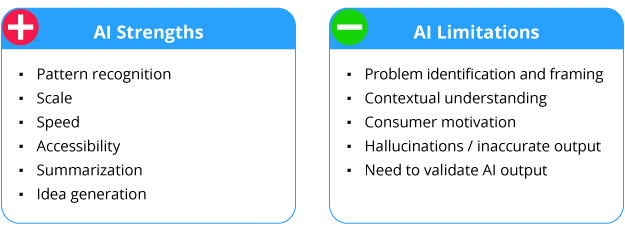
- Determining what problem needs to be solved is a critical component of the research process. AI is good at ferreting out information and identifying patterns. It can also suggest hypotheses, recommend methodologies, and even draft questionnaires. But organizations still need to decide what they are trying to learn, what evidence will be credible, and how the findings will influence their decisions.
- AI often accepts the business question at face value. But, good researchers know how to challenge assumptions and reframe the question so that they are solving the right problem.
Contextual understanding
- AI is really good at digesting and summarizing qualitative data. However, qualitative interviewing is a dynamic conversation, and AI can often miss the nuance in tone and context within that conversation. As John Warner, our friend and former colleague, explains in his book about writing and AI, AI does not really think but instead is particularly good at finding patterns in syntax.
Understanding “the why”
- Similarly, AI is often very effective at describing patterns in behavior. Understanding why those patterns exist is frequently more complicated. Yet, understanding consumer motivation is invaluable to client decision-making.
Grounding the conclusions
- Research findings rarely exist in isolation. The significance of a result often depends on the competitive landscape, market trends and conditions, and prior learning. Interpreting findings within that broader context remains an important part of research.
AI Hallucinations
- Perhaps the scariest risk is that AI can produce “hallucinations,” or incorrect output. A hallucination occurs when an AI system generates information, conclusions or explanations that appear plausible but are not adequately supported by actual data.
- AI hallucinations can take several forms. The most obvious are hallucinated “facts,” where AI invents statistics, respondent quotes, or findings that do not exist in the underlying data. AI can also mistakenly present simple correlations as cause-and-effect relationships. AI can also generate weakly supported insights and conclusions with a level of certainty that makes them appear more valid than they really are. AI hallucinations can be seductive and difficult to detect.
Validating the Output
- With all of these limitations, researchers must spend time carefully evaluating and validating AI output to ensure that it is grounded in the data. The validation stage can take a considerable amount of time and, even then, still fail to detect errors in output, and miss important insights that would have been captured through more traditional analytic methods.
As AI automates more technical tasks, human judgment and critical thinking actually become more central to delivering trustworthy research and helping organizations make sense of the data and move forward with their strategic decisions.
AI Strengths and Limitations
Why Surveys Continue to Matter
One question that arises frequently is whether AI will reduce the need for surveys. I believe that surveys remain one of the most important tools in market research because they generate new and original data – data that are specifically designed to be highly relevant to the client and its market. Most AI systems work with more general information that already exists.
When organizations need to understand awareness, attitudes, perceptions, purchase intent, customer satisfaction, or reactions to a new concept, they often need to collect information directly from the people they serve. AI can streamline many parts of the research process, but it does not eliminate the need for direct customer input.
The continued investment of major research firms in survey-based methodologies alongside AI capabilities suggests they see these approaches as complementary rather than competing.
A Final Thought
The most interesting aspect of AI may not be that it changes research. It may be that it changes the economics of information. Information is easier to gather. Patterns are easier to identify. Hypotheses are easier to generate.
What remains difficult is determining which evidence deserves trust and which findings should influence decisions.
For research buyers today, the most useful questions remain surprisingly familiar:
- What evidence supports this conclusion?
- How were the findings validated back to source data?
- What assumptions were made?
- What information might still be missing?
I was fortunate to start my career in a firm that was committed to answering client questions by drawing on social science research principles and methodologies. While the specific tools we use have changed dramatically over the years, the fundamentals of good research have not. In my experience, important insights never emerge from technology alone. They arise when thoughtful inquiry and sound research come together to illuminate a decision.
AI is an important addition to the research toolkit. It can help researchers process information more efficiently, explore ideas more broadly, and make insights more accessible across organizations.
But, the goal of research, as always, is to help organizations make better decisions with greater confidence. And that still depends on asking the right questions, gathering valid and reliable data, and interpreting it thoughtfully. These responsibilities will continue to be the cornerstone of good research.